


Page 116 - Microsoft Word - miniz-digest-92-97.docx
P. 116
British & Dutch buildings


            In  my  last  article  I  promised  you  news  of  some  exciting  new  items  from  Rutherford’s,  but  I’m
            afraid I’ll have to hold these over till next time as they’re not available yet. They are producing
            decanters in celebration of both the London Olympics and the queen’s diamond jubilee. They’re
                                                                       th
            also doing a couple of pieces in commemoration of the 100  anniversaries of both the Titanic and
            Scott’s expedition to the Antarctic. And if that’s not enough, there’ll also be a jug depicting the
            royal yacht Britannia, and yet another that sports a new image of Concorde. These will be made up
            of a mixture of jugs and book decanters. I’m also waiting to take delivery of a couple of new items
            from Pointer’s. These will include a queen’s diamond jubilee piece and at least one new footballer.
            I’ve been assured that all of these items will be with me in time for the next newsletter, so watch
            this space!


            For this article I thought I’d give you an insight into some of the
            fabulous  ceramics  that  have  been  produced  through  the  ages
            that  depict  famous  British  buildings  and  landmarks.  These
            would have been produced up to 30+ years ago.


            The first group of ten were issued by Mini Bottles (UK) Ltd., and
            represent  some  of  the  better  known  historical  buildings  from
            around Great Britain.

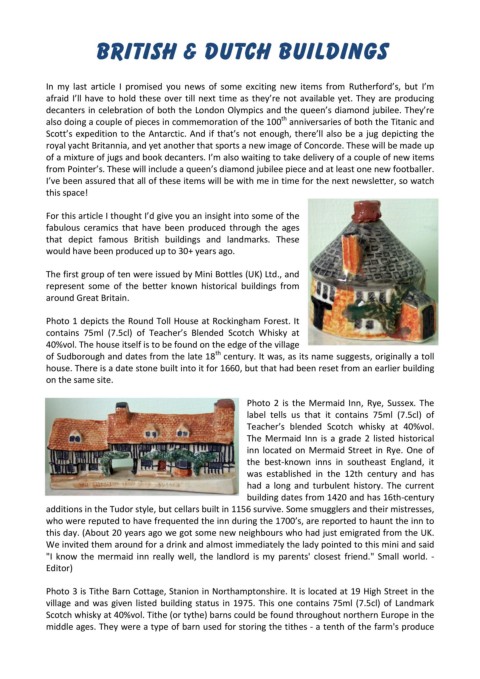
            Photo 1 depicts the Round Toll House at Rockingham Forest. It
            contains  75ml  (7.5cl)  of  Teacher’s  Blended  Scotch  Whisky  at
            40%vol. The house itself is to be found on the edge of the village
                                                      th
            of Sudborough and dates from the late 18  century. It was, as its name suggests, originally a toll
            house. There is a date stone built into it for 1660, but that had been reset from an earlier building
            on the same site.


                                                              Photo 2 is the Mermaid Inn, Rye, Sussex. The
                                                              label  tells  us  that  it  contains  75ml  (7.5cl)  of
                                                              Teacher’s  blended  Scotch  whisky  at  40%vol.
                                                              The Mermaid Inn is a grade 2 listed historical
                                                              inn located on Mermaid Street in Rye. One of
                                                              the  best-known  inns  in  southeast  England,  it
                                                              was  established  in  the  12th  century  and  has
                                                              had  a  long  and turbulent  history.  The  current
                                                              building dates from 1420 and has 16th-century
            additions in the Tudor style, but cellars built in 1156 survive. Some smugglers and their mistresses,
            who were reputed to have frequented the inn during the 1700’s, are reported to haunt the inn to
            this day. (About 20 years ago we got some new neighbours who had just emigrated from the UK.
            We invited them around for a drink and almost immediately the lady pointed to this mini and said
            "I know the mermaid inn really well, the landlord is my parents' closest friend." Small world. -
            Editor)

            Photo 3 is Tithe Barn Cottage, Stanion in Northamptonshire. It is located at 19 High Street in the
            village and was given listed building status in 1975. This one contains 75ml (7.5cl) of Landmark
            Scotch whisky at 40%vol. Tithe (or tythe) barns could be found throughout northern Europe in the
            middle ages. They were a type of barn used for storing the tithes - a tenth of the farm's produce

