


Page 90 - Microsoft Word - miniz-digest-80-85.docx
P. 90
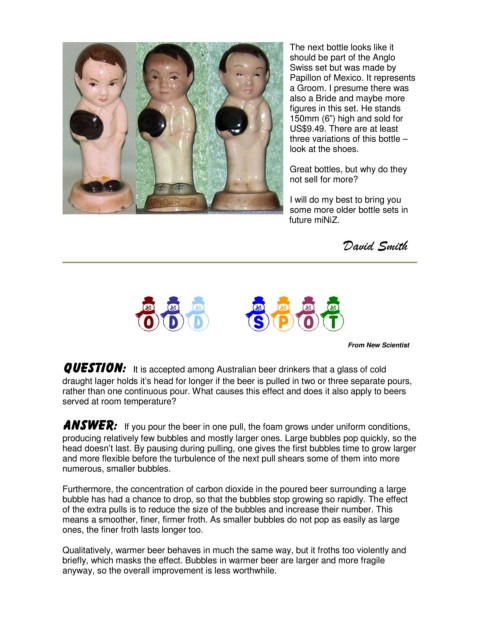
The next bottle looks like it
                                                                           should be part of the Anglo
                                                                           Swiss set but was made by
                                                                           Papillon of Mexico. It represents
                                                                           a Groom. I presume there was
                                                                           also a Bride and maybe more
                                                                           figures in this set. He stands
                                                                           150mm (6”) high and sold for
                                                                           US$9.49. There are at least
                                                                           three variations of this bottle –
                                                                           look at the shoes.

                                                                           Great bottles, but why do they
                                                                           not sell for more?

                                                                           I will do my best to bring you
                                                                           some more older bottle sets in
                                                                             future miNiZ.

                                                                                     David Smith


                                                                            O
                                                                                   T
                                                                      P
                                                        SSPPOOTT

                                                               S
                                   O OO OD DD DD DD D SPOT
                                                                                                From New Scientist


                 Question:  It is accepted among Australian beer drinkers that a glass of cold
                 draught lager holds it’s head for longer if the beer is pulled in two or three separate pours,
                 rather than one continuous pour. What causes this effect and does it also apply to beers
                 served at room temperature?


                 Answer:  If you pour the beer in one pull, the foam grows under uniform conditions,
                 producing relatively few bubbles and mostly larger ones. Large bubbles pop quickly, so the
                 head doesn’t last. By pausing during pulling, one gives the first bubbles time to grow larger
                 and more flexible before the turbulence of the next pull shears some of them into more
                 numerous, smaller bubbles.

                 Furthermore, the concentration of carbon dioxide in the poured beer surrounding a large
                 bubble has had a chance to drop, so that the bubbles stop growing so rapidly. The effect
                 of the extra pulls is to reduce the size of the bubbles and increase their number. This
                 means a smoother, finer, firmer froth. As smaller bubbles do not pop as easily as large
                 ones, the finer froth lasts longer too.

                 Qualitatively, warmer beer behaves in much the same way, but it froths too violently and
                 briefly, which masks the effect. Bubbles in warmer beer are larger and more fragile
                 anyway, so the overall improvement is less worthwhile.

